

Your Cart
No products in the cart.
VAT:
0,00 €
Insured Delivery:
Free
Total:
0,00 €

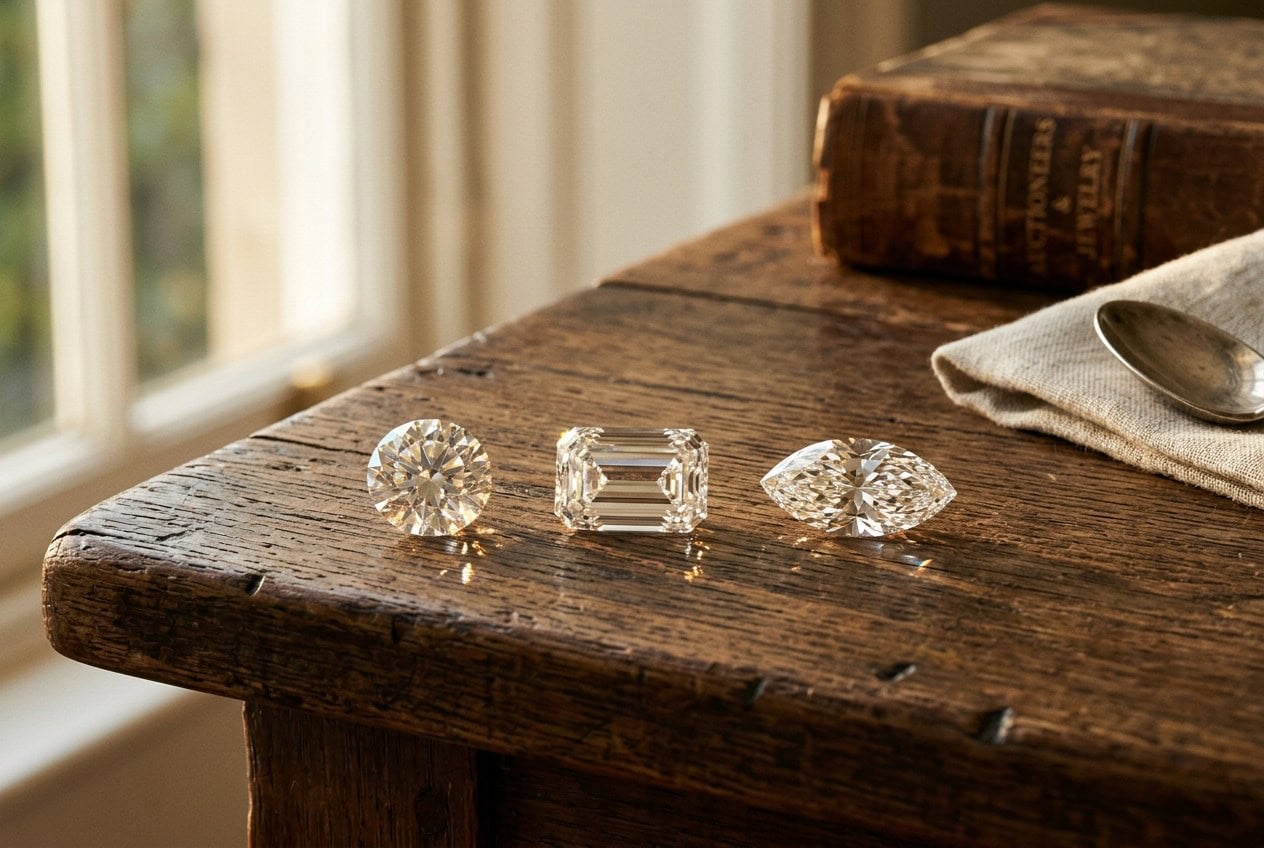
I have been in this business long enough to remember when selling a non-round diamond meant you had to justify it. The question was always: ‘Why not a round?’ Today, the question is: ‘Why would you?’
The data is unambiguous — and it comes from actual transaction flows, inventory turns, and the kind of numbers that keep capital tied up or free it. The round brilliant still holds the largest single share, somewhere between 26% and 62% depending on whether you measure unit sales or carat weight. That range itself tells you something: the market is fracturing. The 26% figure reflects share by carat weight; the 62% reflects unit sales — a gap that reveals consumers buying fewer but larger rounds.
The round brilliant owes its legendary brilliance to 57 or 58 precisely arranged facets. With a refractive index of 2.42 — the highest of any transparent gemstone — it achieves total internal reflection when facets meet the critical angle of 24.5 degrees. Light enters, bends, reflects internally, and exits through the crown, creating brilliance, fire, and scintillation. If proportions are off, light leaks out the pavilion, and the diamond appears dark and lifeless.
Marcel Tolkowsky published ‘Diamond Design’ in 1919, the first mathematical analysis of optimal diamond proportions. He calculated ideal parameters: total depth 59.3%, table diameter 53%, crown angle 34.5°, pavilion angle 40.75°. His work, done without computers, laid the foundation for every round brilliant cut today. The GIA’s 15-year cut grading study now scores brightness, fire, scintillation, polish, and symmetry. Only a small percentage of submitted diamonds achieve ‘Excellent’ — a reminder that cut quality, not shape, is the real driver of beauty.
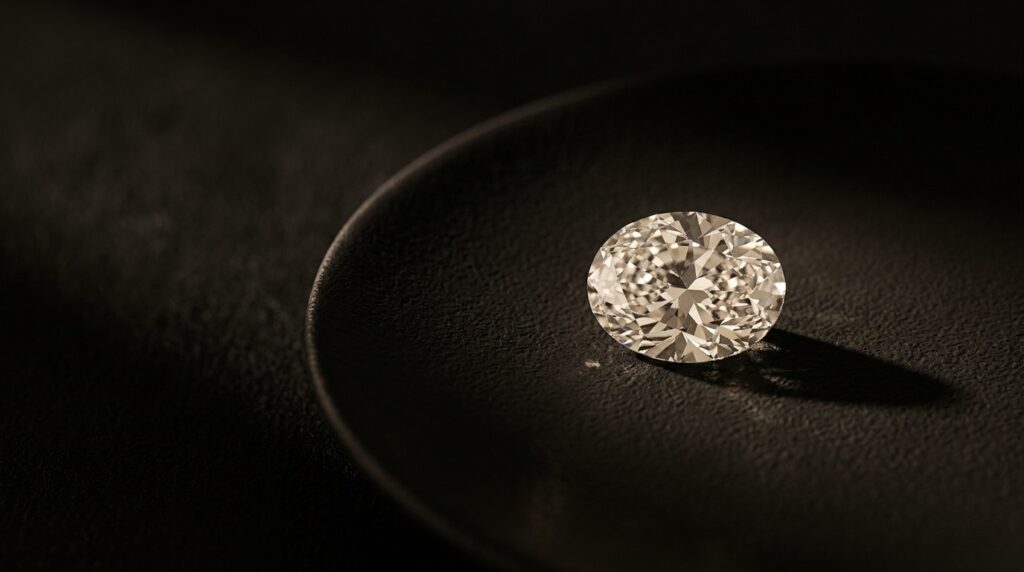
The oval cut has surged 57% in demand over three years, now holding 25–33% of the fancy-shape market. Its elongated silhouette offers a brutal arithmetic advantage: a 1-carat oval measures approximately 7.7mm in length versus 6.5mm for a round of the same weight. That 18% visual size gain for no extra carat cost is why savvy buyers are flocking to ovals. In the 2.5–2.99 carat range, high-quality ovals now command a 5–10% premium. The bow-tie effect — a dark shadow across the center — is the main risk, but precision cutting and 360° video inspection have made it avoidable.
The emerald cut takes an entirely different approach. Instead of maximizing sparkle, it prioritizes clarity and geometric precision. Its step-cut facets create a ‘hall of mirrors’ effect — crisp, linear flashes that appeal to buyers with an architectural sensibility. The large, open table acts as a magnifying glass: inclusions that would hide in a brilliant cut become obvious here. Emerald cuts require VS2 clarity or better, and D–F color to maintain an icy white appearance. At roughly 8% market share, this is a connoisseur’s choice, not a budget option. But demand is growing from the same minimalist aesthetic driving luxury furniture and watch design.
The princess cut is the value powerhouse. As a square modified brilliant with up to 57 facets, it delivers genuine brilliance at 20–40% less per carat than a round brilliant. Its sharp corners, however, are vulnerable to chipping — protective V-prong or bezel settings are non-negotiable. Returns from chipped corners kill margins. At roughly 8% market share, the princess cut offers a modern, geometric look that appeals to buyers seeking uniqueness without sacrificing sparkle.
Pear and marquise cuts each hold about 8% of the market, but their visual impact is outsized. A 1-carat marquise stretches to 10mm in length — nearly 50% longer than a round of the same carat weight. The pear cut combines round-like fire with a teardrop silhouette that elongates the finger. Both require protective settings at their pointed tips, and marquise cuts show color readily, making G grade or higher essential. These shapes are not novelties; they are the logical endpoint of a market that values perceived size above all.
Fancy shapes now account for the majority of demand growth. Elongated stones lead because they deliver the most visible size per carat, a trend accelerated by lab-grown diamonds. When rough is grown in a reactor, not mined, the yield penalty for round cuts disappears. The premium for rounds becomes purely a brand construct, not a supply constraint. Meanwhile, only about 20% of mined diamonds are gemstone quality, and of those, a small fraction earn an Excellent cut grade. A well-cut oval at SI1 clarity outperforms a poorly-cut round at VS1 every time. The information asymmetry that once protected the round brilliant — buyers couldn’t easily compare stones — is gone. Today, every buyer can inspect 360° video, GIA reports, and real-world photos before purchase.
If you are holding inventory of rounds with ‘Very Good’ cut or below, move them now. The window is closing. If you are buying for yourself, ignore the marketing and look at the data: cut quality, not shape, determines brilliance. The round brilliant had a good run. But the crown is no longer secure.
At AZENA Gems, we offer lab-grown diamonds in every shape, IGI certified, delivered EU-wide. Whether you want a precision-cut oval or a flawless emerald, our data-driven selection helps you find the stone that maximizes beauty for your budget. Start your journey today.
Originally reported by caratx.com.







No products in the cart.